Tuesday, 12 July 2016

AN EMOTIONAL JOURNEY TO A WEBSITE - Web Design Company


Digital presence now a days have become equally important for businesses, as physical presence in the market. This is the reason organizations now embark on client’s journey for physical and online markets.
A decade before, customers only had access to a certain store fronts. With the technological boom and the availability of online channels such as webs, social media and mobile applications, people can shop easily and efficiently. These digital passage have altered the way we interact with businesses and products.
Now a days when people are surfing online, their journey goes beyond the website. Web Design Company try to ensure that they develop a web which is bespoken for the businesses. There are various communication channels which range from email to messengers, social media and applications. People have many opportunities where they can interact using these platforms for endless impression. For businesses online, they need to have an understanding about the customer preferences and choices so they can address their needs in the best possible manner.
Talking about the physical world, when a client go to the shop, seller can actually interact with the buyer, which is why he can see his ER Emotional Response. ER is very important when dealing with the people while dealing physical and it is of similar importance when it comes to digital presence. This offer valuable data and make the seller optimize and efficiently mold their processes.
This point is very significant when people move to digital and huge market exist online. The challenge over here is that seller and buyer cannot see each other. This is the reason that alternate methods have been introduced such as feed backs, quick chat boxes etc. to get customers view. This process has made process of selling difficult as compared to physical presence. Much more challenging strategies are required now to completely understand people preferences. Web professionals are now introducing several of the techniques to meet these challenges through following ways:
Click Here for More: Web Development Company
Messaging – In order to make sure that website remain spoken, professional designers are actually using chat boxes on the website. This make sure that they interact with the clients, which helps the web owner to articulate different from other businesses.
Click Here for More: Web Design Company
User Personas – Great Web Designs and fancy colours, in short web persona is key to attract customer emotionally while using digital platform. This emotional presence helps the clients get attracted and feel what the website is offering.
Search Engine Optimization SEO – To reach the client without any hassle and to make the most out of it, keyword discovery and digital mapping plays a very vital role. It says, where there is business there is competition. Search engine optimization helps businesses to make their website visible to people.
Click Here for More: Mobile App Development
Website usability is very important to help people navigate through it effectively. Now a days, website is more about connecting the dots and to maximise user experience with the help of aforementioned tools. The Success Saga is to have several digital interaction channels while business is on website.

Monday, 11 July 2016

15 Entertaining WordPress Themes - Web Design Company

Themes for different sites and pages play an integral role in keeping the Web Design Company, Web Development Company and Mobile App Development  on a firm track. It is the first impression about the company that gets engrossed in the viewers mind. Designing themes for your sites is an interesting job, and one getting hands on it surely gets an edge over others. Here is a collection of 15 Entertaining WordPress Themes based on different categories like wedding, food, music etc. Take a look and get inspired by these amazing WordPress themes.

Wedding Day – Responsive WordPress Theme

Why to purchase?
  • It is well integrated with Facebook, Twitter and Google +
  • It offers cross browser optimization
  • It has the social media
  • It has got a styled layout and column

SoundWave – The Music Vibe WordPress Theme

SoundWave - The Music Vibe WordPress Theme - Nightlife Entertainment
Why to purchase?
It offers some really exciting special and social features, and much more. It allows audio, video, events, photos etc to get added in an organized manner.
LaMonte – Modern Restaurant WordPress Theme
LaMonte - Modern Restaurant WordPress Theme - Restaurants & Cafes Entertainment
Why to purchase?
The theme is much responsive offering simple and unbranded theme options. It also features custom widgets, Multi Level drop down menu, auto image resizing, page template and many others.
LemonChili – a Premium Restaurant WordPress Theme
LemonChili - a Premium Restaurant WordPress Theme  - Restaurants & Cafes Entertainment
Why to purchase?
  • Cross Browsing Compatibility
  • SEO Optimized
  • Nivo Slider
  • Skeleton Grid System
  • Google Analytics Integration
Cooky Restaurant Responsive WordPress Theme
Cooky Restaurant Responsive WordPress Theme - Restaurants & Cafes Entertainment
Why to purchase?
  • Responsive Design
  • Sidebar Generator
  • Page Builder
  • Custom and Responsive menu
Solar – Video WordPress Theme
Solar - Video WordPress Theme - Film & TV Entertainment
Why to purchase?
  • Responsive Layout
  • Demo Content Inclusive
  • Inclusive of Photoshop files
  • Retina Support
Ensconce – Responsive WordPress Video Landing Page
Ensconce - Responsive WordPress Video Landing Page - Entertainment WordPress
Why to purchase?
It is fully responsive and has got 50+ theme options. It features 9 color pickers for unlimited color combination. The theme is super easy to customize and is powered by Twitter Bootstrap.
Wedding vow – Responsive WordPress Theme
Wedding vow - Responsive WordPress Theme - Events Entertainment
Why to purchase?
  • Clean Design
  • Images can be viewed with PrettyPhoto
  • Google Web Fonts
  • Got the Coross Browsing compatibility
GIG Premium WordPress Crowdfunding Theme
GIG Premium WordPress Crowdfunding Theme - Entertainment WordPress
Why to purchase?
The above theme offers a dedicated events solution for your band and makes you get closer to your fans with dedicated band member pages. It comes complete with a total of  12 unique page templates and it supports many Post Formats.
Food & Wine – Responsive WordPress Theme
Food & Wine - Responsive WordPress Theme - Restaurants & Cafes Entertainment
Why to purchase?
  • Fully Responsive Layout
  • 500+ Google Fonts
  • Configurable Footer
  • Theme Options Panel
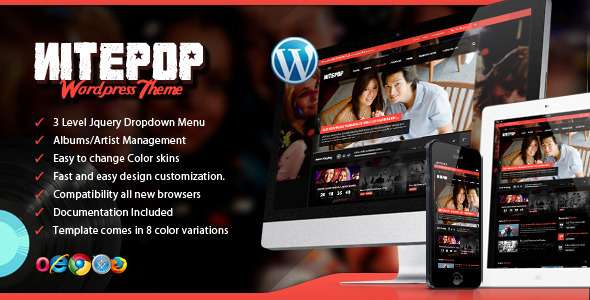
Nite Pop – Music Band/Artist WordPress Theme
Nite Pop - Music Band/Artist WordPress Theme - Events Entertainment
Why to purchase?
  • Slidebar and Sidebar Management
  • Powerful Theme Options
  • Event and Gallery Management

Rock4Life- Responsive WP-Theme for Bands/Musicians

Rock4Life- Responsive WP-Theme for Bands/Musicians - Nightlife Entertainment
Why to purchase?
  • Filterable, Animated Photo and Video Gallery
  • Jquery Animations
  • Valid HTML5 / CSS3
  • Modern and responsive Design

Muse: Music Band Responsive WordPress Theme

Muse: Music Band Responsive WordPress Theme - Entertainment WordPress
Why to purchase?
It is  tough WordPress theme yet a highly responsive one. It features Retina Ready, Grid Based Layouts, Touchable Lightbox for Image viewing, Touchable full screen Slide Show and has many other remarkable attributes.

Fine Food – Restaurant Responsive WordPress Theme

 Fine Food - Restaurant Responsive WordPress Theme - Restaurants & Cafes Entertainment
Why to purchase?
  • Event Management
  • Layered PSD Files Inclusive
  • Multiple Gallery Layouts
  • Great Sliders
  • Responsive Design

SOUNDANIMAL Complete Entertainment WordPress Theme

SOUNDANIMAL complete entertainment wordpress theme - Entertainment WordPress
Why to purchase?
  • Responsive Design
  • Well Structured Markup
  • PrettyPhoto
  • Flicker Widget

Web Design Company
Web Development Company
Mobile App Development

Monday, 13 June 2016

6 WEB DESIGN TRENDS YOU MUST KNOW FOR 2016

Who can forget the GIFs of the ‘90s, or the more up-to-date focus on flat design?
Recently, we’ve seen a surge in popularity of responsive Web Design Company, as more and more sites join the drive to become ‘mobile ready’ which is now even more important in the wake of Google’s Mobile Friendly update.
Let’s examine some of the most popular for this and the coming year.

1. The Proliferation of UI Patterns

One of the side effects of responsive design has meant that a lot of sites look similar. However, responsive design isn’t solely to blame. The rise of WordPress sites and the booming theme market also have a hand in it. And some folks, such as Matthew Monbre, have copped to being guilty of following everyone else’s look with his company’s site.

But having a similar look isn’t necessarily a bad thing. That’s because we’ve changed the way we consume the web, which has resulted in a lot of common UI design patterns. Design patterns have matured and as such, there’s little in the way of innovation when it comes to UI patterns.
In other words, a checkout will still be a checkout and should function as such. Same with a login model. There’s no real reason to reinvent the wheel. UI patterns must guide users through a smooth experience.
Here’s a few patterns you should be familiar with:
1- The hamburger menu: While some criticize this pattern’s use, there’s no doubt that it’s widespread use makes the function easily recognizable for users.
2- Account registration: You’ll find this pattern whenever you try to register for a site. There might be a form to fill out or a button that’ll allow you to use a social account to sign up. Multi-step form wizards are also effective since they “chunk out” the required fields, reducing friction and encouraging users to flow through the process.
3- Long scroll: Placing all your important elements above the fold is now a well-known myth. Furthermore, almost everyone is accustomed to long scrolls thanks to mobile devices. The technique works especially well for sites that want to lure users through storytelling, and you can still mimic a multi-page site by breaking the scroll into clear sections.
4- Card Layouts: Pioneered by Pinterest, cards are everywhere on the web because they present information in bite-sized chunks perfect for scanning. Each card represents one unified concept. Since they act as “content containers”, their rectangular shape makes them easier to re-arrange for different device breakpoints.
5- Hero images: Since vision is the strongest human sense, HD hero images are one of the fastest ways to grab a user’s attention. Thanks to advances in bandwidth and data compression, users won’t suffer from slow load times either. One common layout you’ll find is a hero image above the scroll, followed by either zig-zagging sections or a cards-based arrangement.

2. Rich Animations

Animations are being used more and more to enhance a site’s storytelling, making the experience more interactive and entertaining.
However, you can’t just stick animation in anywhere. Consider carefully whether it adds to your site’s story elements and personality. Animations can be thought of in terms of two groups:
1- Large scale animations. These are used as a primary interaction tool have more impact on users and include effects like parallax scrolling and pop-up notifications.
2- Small scale animations. These include spinners, hover tools and loading bars, and don’t require any user input.
We’ll describe 7 of the most popular animation techniques:
- Loading animations
These are used to entertain users and delight users during an otherwise tedious experience. Loading animations tend to be popular for flat design, minimalism, portfolios and one-page sites.
Keep them simple and avoid adding sound. They should however match your site’s personality and color palette.
Hidden navigation menus have become increasingly popular, especially as they can be used to save screen space. As you can see in the example below created in the collaborative prototyping tool UXPin, these use animations to reveal a menu when clicking on a specific button and prevent a jarring transition (like a navigation drawer hidden behind a hamburger icon).
- Hover animations
Hover effects give a more intuitive feel to a site as users mouse over content. Users unsure about a feature’s function tend to hover over them automatically for instant visual feedback.
Galleries and slideshows are an effective way to showcase multiple images without overburdening the users. These are great for photography sites, product showcases, and portfolios.
Our eyes are naturally drawn to motion, which makes it the perfect tool for drawing a user’s attention. Motion can also help with visual hierarchy. This can help to add interest and intrigue to forms, CTAs and menu items.
6-web-design-trends-redsignal-10
- Scrolling
Smooth scrolling relies on animation and gives further control to the user, who can determine the pace of how the animation unfolds.
6-web-design-trends-redsignal-11
- Background animations/ videos
A simple animated background can add visibility to a site, but should be used in moderation or it can be very distracting to the user. The key is to work on individual sections or create a gentle movement of an entire image.
6-web-design-trends-redsignal-12

3. Microinteractions

Microinteractions happen all around us, from turning off the alarm on your mobile phone to liking that cat picture on Facebook.
Each one done without a second thought. It’s likely that you started your day with a micro-interaction. By turning off the alarm on your mobile phone, you engaged with a user interface in a single moment. And more and more of these are baked into the apps and devices we use.
6-web-design-trends-redsignal-13
Micro-interactions tend to do, or help you do, several different things:
1. Communicate a status or bit of feedback
2. See the result of an action
3. Help the user manipulate something
Micro-interactions are a vital part of any app.
As recommended in Web Design Company Trends 2015 and 2016, you’ll want to ensure that these interactions happen almost invisibly. Don’t go overboard and keep it simple. Consider each detail with care, and make each interaction feel human. That is make text conversational and not robotic.
Micro-interactions are an important part of almost every digital design project. You’ll be hard-pressed to design a website or mobile app that does not include some element, or moment, that a user needs to interact with.
Each of these interaction types lead users to a path of more human-centered design. This concept of making devices more human-like in their moments is a key to adoption and usability.

4. Material Design: A Richer Alternative to Flat Design

Last year, Google launched its new style language, Material Design. It uses shadow effects and the concepts of movement and depth in order to create designs that appear more realistic to the user.
6-web-design-trends-redsignal-14
The goal of Material Design is to create clean, modernistic design that focus on UX. While Google’s design aesthetic has detractors, it’s been mostly praised as a game-changer.
With its minimalistic look, Material Design has a lot in common with another growing trend — flat design. Material Design, however, makes use of depth and shadow, which allows for more depth than pure flat design.
6-web-design-trends-redsignal-15
Before now, we’ve seen the majority of Material Design projects limited to app design. Google however announced Material Design Lite in July, which is more suited to websites. Nevertheless, Material Design was intended to provide great UI and UX across devices. Lite uses vanilla CSS, HTML and JavaScript and is intended to make it simple to add the look and feel of Material Design to websites.
Material Design Lite doesn’t rely on any particular framework, so designers can use a wide variety of front-end tools to create their sites. It’s also lightweight when it comes to the code.

5. Responsive Design

Responsive web design has become incredibly popular in recent years thanks to the rise of mobile internet usage.
6-web-design-trends-redsignal-16
It’s safe to say responsive design isn’t going anywhere soon, as it represents a relatively simple and cheap way for businesses to build a fully-functional mobile-friendly site. But responsive web design does come with some issues if not carried out properly, the most important being performance.
To ensure that a responsive performs at the peak of its ability, according to Guy’s Pod, designers should:
1. Avoid using JavaScript and CSS image loading using the display:none tag. This still downloads the image to the device and adds unnecessary weight to a page.
2. Use responsive images which are defined using a percentage.
3. Use conditional loading for JavaScript as many of the JavaScript components used on a desktop site will not be used on smaller devices. Pay particular attention to third-party scripts such as those used for social sharing as these often impact negatively and reduce performance.
4. Use RESS – Responsive and Server Side
5. Apply performance testing into the process in order to effectively measure and optimize each site.
Performance is important not only to UX, but also to Google in the wake of the Mobile Friendly update which released in April 2015. Responsive web design is also highly compatible with minimalism, thanks to the necessity to keep page weight down. It’s also great to work with cards and responsive design as they can easily restructure in order to fit any breakpoint or screen size (like rearranging rectangular containers of content).
6-web-design-trends-redsignal-17
Responsive web design is becoming less of a trend and more of a best practice. And designers have come up with clever ways to get around any speed issues.
There’s no doubt that responsive design is highly useful and versatile, but it also should be lightning fast in order to deliver a great UX

6. Flat Isn’t Going Away Anytime Soon

Flat design has been around for a while and is compatible with other trends such as minimalism, responsive web design and Material Design.
6-web-design-trends-redsignal-18
Going forward, it’s likely that we’ll see the following further trends in flat design come to the forefront.
- Long shadows. These bring more depth to flat designs.
- Vibrant color schemes. Popular UI frameworks and templates have prompted many to begin using more vibrant colors in their designs.
- Simple typography. Simple typefaces help to ensure that text remains legible and readable in flat design.
- Ghost buttons. These allow for functionality without distracting from the UX and are often represented as outlined, clickable links that change when the user hovers over them.
- Minimalism. Looks to cut down on the number of elements in order to create a fresh, uncluttered UI.

Additional Advice on Web Design Trends

Don’t follow trends just because they’re the “hip” thing to do at the moment. Trends represent popular techniques for good reason, but make sure it’s best for your users. For example, an e-commerce site certainly wouldn’t do well as a single-page infinite scrolling site.
Trends are nothing more than additional tools in your designer toolbox. Always pick the right ones for the job.

Thursday, 9 June 2016

Ultimate Design Guidelines For Mobile E-commerce


Rapturous technological commotion in smartphone mania has led to unprecedented smartphone user base. Interestingly, these users are getting more and more interested in buying and shopping with their swipe, tap and pinch gestures. This newly found buying behavior of smartphone users has brought new adventures for E-sellers and with some wise and well planned user experience techniques, they can really take their sales to the top.

Success of any e-commerce project hinges upon how well e-seller intuits what consumers want.

Latest research reports rolled out by various institutions, authenticate too by Google’s head of global mobile sales and strategy, Jason Spero, show that frustrated mobile experience lets users tear down their pre-conceived brand notions, only to take their wallets out at some other seller. On the other hand, if a brand successfully manages to stoke customers’ aesthetic lust and triggers delightful user experience, consumers happily engage themselves into business with those brands. Nevertheless, creating such a delightful user experience is not an easy task for designers.
Note: This article specifically has been written in context of design approach relating only to mobile sites and apps.
Keeping consumers’ behavior in account, we can try out the design rules that have now been raised to the standards of web & mobile scriptures, and following them would at the least, if not resounding success,  help you avoid utter failures.
Let’s first start with design approach relating to mobile E-commerce usability and accessibility to be fine-tuned into Home Page, Interface Navigation Modeling, Product Displays, Shopping Carts and Checkout Process.

Home Pages

In mobiles’ perspective, home pages have to stand for different purpose other than clipping bits of entire web pages. They are rather about providing users up front what they are looking for. For this reason, home pages must only carry the most important bits of information such as search products, product categories, links to featured site area and promotional stuff etc.  Generating strong yet balanced visual impact is strongly recommended in portraying desired information on home pages.

Tiled Layout, commonly referred as single column display can help in showing ‘site information’ elegantly without running the risk of being cluttered and littered. From this tiled interface, users would move any way they desire and see what they are looking for. Following examples reflect some nice Home Page design trends.
Tiled Links Listing extending downwards acts as central hub for moving onto important site areas. Similarly, visual marketing propagation puts makes home page rather close to perfection.

Read More About:
Mobile App Development

Global Navigation Modeling

Though Home Page often acts as seamless hub for remaining site areas yet separate navigation space model is required to fine tune users’ site experience. The key here is simplifying the things as ‘Simplicity equates usability’ where as complexity leads to perplexity. Applying too much pagination and information ramification would terribly play down at whole site/app structure.  So, while designing, it is core responsibility of designers to figure out interface which could imbue all paradigm shifting features at the surface and nothing important is buried under mazy layout. Side Bar Navigation lets users quickly move back and forth in all site areas fearlessly. For large E-commerce stores, such an interface helps categorizing informational architecture.Though all information is categorized yet end impact is 'cluttered'. Navigation Interface should be harmonic; either single columned or double columned There are different design approaches in which main site navigation can be steered up. Most commonly seen navigation is normally header/footer based but trend of ‘Side Bar navigation’ has been rising lately. Facebook iOS app is prime example of this latest roll in/roll out navigation. Unlike sticky navigation, this navigation menu shows up only when thumb is rolled from the sides of screen. Hover controls, Symbolical icons and in page modal windows don’t only help simplifying things, they also empower users to control information the way they want to see. ‘Aesthetics’ is still powerful key to trigger the emotions which may increase consumers’ buying probability.

Product Displays


Single Page Scrollable Product Display Categorical product management with strong visual displays and sufficient ‘unique selling points’ can never be more important than they are now. Initially products can be shown either in table displays or even in grid display. Particular product can also be shown through two different ways, first ‘single page product display’ and other ‘tab format’ allowing chunked product display with relevant marketing mix details as shown in the Accordion/Tab oriented product display applied by Samsung Samsung's product display . ‘You only see what your eyes want to see’ and you would see what your mind wants to see’. Contrary to tab/accordions display, Single Page Product Display urges users to do lot of scrolling but it finally liberates users from working with accordions or tabs carrying detailed product information.Office Depot rolls out such a product display as can be seen in figure here.How much products could be and should be shown in product pages? You can sell only those products to consumers which you can have shown them, particularly in mobile environs. But at the same time, large number of products shown collectively also betray to bafflement. So, for large retailers, it’s challenging to choose which products to show and which to not. I may have not any data to support which products would score best on your front lines, but we can surely have ample anecdotal data to learn ‘how’ any products on the site floor can get more and more customers.


Read More: Web Design Company

Shopping Carts

Even the best products would fail when shopping cart layout is quirky and flashy. Shopping cart must only carry the information that is highly requisite and indispensible such as save order, add to favorites, delete order, update order shipping information and checkout etc.
Any frustration or dead end at this ending phase of purchase could ultimately lead to shopping cart abandonment which is a total nightmare for any e-seller. Nevertheless, keeping things intuitively aligned and available on page would substantially increase conversion rates. In order to ensure information accessibility, like on product pages, here on shopping cart, you can again employ ‘tabs/accordion’ display pattern which will allow users to see their order details rather in intelligible chunks.

Checkout

‘Seal the Deal’. It’s more of a process than any pattern, so usability and functionality are crucial for maintaining efficient conversion rate. Checkout process inherently involves number of steps, at the least 4 to 5, initiating from shopping cart to confirm order. Established brands can use as many steps as they like because consumers are pretty much sure in their purchase with them. On the other hand, newer brands or small retailers must have to be strictly specific about the information that they want for moving their products to the consumers. Well, regardless of number of steps involved in a checkout process, most important thing is to design this checkout process in uni-dimension; i-e, linear. Unlike non-linear checkout process which is intimidating and frustrating for users due to its randomly propelling steps into steps layout, linear checkout process is end-destined, never to incur back and forth engagements. So, secret to ensure usability is to make checkout ‘linear’ and ‘smart’.

Quick Recap

With exponential increase of smart phone users, e-commerce are seeing highly attractive marketplace to sell their products. Now it’s designers who are key players of running their mobile storefronts successfully. We have seen above that
  • Home pages must seamlessly show up as hub of important site areas. Strong visual identity is rather crucial for initially impressing consumers and keeping them rabidly engaged with site content.
  • Global Navigation must be ubiquitous, even when being rolled out through user 'gestures'. Making use of gestures is quite interesting but don't abuse them.
  • Product pages are content nucleus and must be designed in way to stoke customer's lust so as to demand desired prices from consumers. These products can be shown through various design approaches including single page product display and accordions/tabs format.
  • Shopping Cart act as product carriers that consumers have opted to buy, either in time or in future. Shopping cart abandonment must be ensured through setting accessibility features upfront in design interface.
  • Checkout process must be uni-directional as back and forth shifts around various site areas would ultimately trigger confusion and intimidation among consumers.

Fundamentals of Social Media and Social Media Marketing

If success becomes challenging, it’s time to master the fundamentals again.
When studied in Social Media Marketing’s context, this rationale weighs even more truth. Businesses are eager to move into Social Media cosmos, and in their efforts, they are going all out to failure. We see hundreds and thousands of businesses desperately trying to socialize themselves through Facebook pages, LinkedIn profiles, Twitter accounts, Pinterest setups, but no body pays them attention. Time wasted, money burnt and focus lost. You call it unfortunate, we know it as Failure.

Question:Why Businesses fail in Social Media cosmos?

Answer: Absolutely ‘No Planning’ or ‘Poorly though out Planning’ or....... When marketers don’t plan, they plan for failure. And, when marketers plan poorly, they plan to fail audaciously. So, why not to stick to 'Fundamentals' again, and redefine Social Media environment; what social media is all about, how users work here, and what it takes to engage with these users. Fundamentals Make the Market and Market approves fundamentals. Yes, believe it or fail…

Social Media Is Real People – Engage with them Intelligently

Today, social media is deeply woven into people’s lives. It’s more like a consumer generated media where consumers gather to listen, talk and share with one another. They listen to those whom they like and, they talk with those whom they know. They share what they believe to be interesting and they discuss what they what they believe worth spreading.
This behavior is quite similar to that observed in daily lives of people. People, to strangers, are moody and are choosy, they are solemn and they are serious. To strangers, they are cautious, they are conservative.
The more a marketer understands similarities between real social life and online social media life of people, the brighter the prospects of his marketing intelligence become.

Being Real to the People Who are Real is the Real Challenge that Social Media Marketers don’t really want to learn…
Did you ever bother to see what’s common among Successful Social Media campaigns? They all were based on building real relationships with social media audience and, strengthening these relationships through consistent follow ups.

Nobody Wants to be Sold – Build Relationship First and Sell Later

The second most important fact worth learning is, ‘Nobody wants to be Sold and that too, sold right away’. Before digging deeper into this behavior, let’s ask a question.

QuestionSocial Media is, ideally, suitable for drawing

1-Direct Sales
2-Direct Audience

It does not mean that businesses cannot get sales leads from social media at all.  It just means that shifting the focus at ‘Drawing Audience’ will ultimately result in ‘receiving leads’. The moment users figure out that the ‘ROI Equation’ is all that a business is interested in, they would not let them get near or engage with.
As said earlier, ‘No Body Wants to Be Sold’.
Users do not spend their days and nights on social media websites to ‘buy products’. They visit these websites to discover, to explore, to observe, to critique and to share. For successful social media campaign, businesses need building ‘repo’ first.
In Social Media landscape, your services are your second introduction. Your first introduction is your activity; knowledge you share, tips you give, discussions you join and people you engage with. Your actions, interactions, reactions and inactions are monitored by people. The moment you engage with them, the very first thing they do is to see who you are, what you are doing and what people are saying about you. Get your answers ready for your viewers.
Having done this, now spice up your business with latest discounts, sales offers and marketing promotions. This is what we call Socializing Business.It takes time, but it gives REAL results.

Read More: Web Design Company

Do in Rome What the Romans Do – Not, as Americans do in Afghanistan

A singer is not a singer only; he can be a father, a brother, a friend and a teacher also. Did you get that?
Let me explain what’s this and what’s it to do with our social media marketing. There is a user, say Brian. He has an account with Facebook. He has an account with Twitter as well. Likewise, he has accounts with Google+, LinkedIn, Pinterest, StumbleUpon, Digg, Tumbler and so on. Brian deals in garments. What he must be doing on all these social networking websites?
It’s wrong if you think that Brian follows same things on these different platforms. Same Brian behaves differently on these different platforms. On Facebook, he must be engaged with his friends, family and relatives, sharing with them light news, entertainment videos, funny images and family event stories. On LinkedIn, Brian must be building his industry relationships, sharing his business intelligence and following business centric information sources. On Pinterest, he must be following latest trends and fresh inventories.  And the story can continue accordingly.
What we learn from Brian, is that, each social platform has its own opportunities, its own challenges and its own dialect, collectively nurturing a particular environment which is suitable for only specific course of actions.

Read More About: Mobile App Development

For successful Social Media Marketing , a business must learn to project its image on these different landscapes, accordingly. Again, do in Rome what the Romans do.